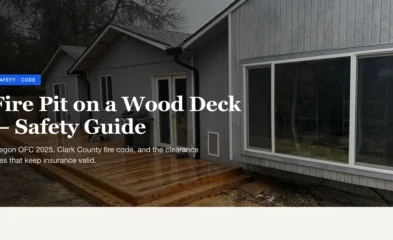
Can You Put a Fire Pit on a Wood Deck? A Builder’s Safety Guide
Yes — with conditions. A fire pit can sit on a wood deck legally and safely, but only when you’ve satisfied code setbacks, used a rated heat barrier, and confirmed your homeowners insurance policy won’t void itself the night a gust catches a cedar ember.
After 15 years building decks across Vancouver WA, Portland OR, and Clark County, our crew at LGC Remodeling has answered this question a few hundred times. Some homeowners are surprised to hear that the answer is never a simple yes or no. It depends on the fire pit type (wood-burning versus gas), the decking material, local fire code in Oregon or Washington, and what paragraph 14 of your insurance policy actually says.
This guide covers all of it — straight, no filler.
The Short Answer — Yes, But the Conditions Are Non-Negotiable
Wood-burning fire pits on any wood deck are the highest-risk scenario. They produce sparks, embers travel downwind, and a single gust can carry a coal 20 feet before it lands in a gap between boards. That said, thousands of Portland Metro homeowners do it every year without incident — because they use the right setup.
Gas-burning and propane fire pits are a different story. They produce no airborne embers, direct heat upward through a controlled burner, and most quality units (Solo Stove Mesa, Weber Fire Pit, Endless Summer LP models) are explicitly rated for deck use by their manufacturers. Check the manual. If it says “approved for use on combustible surfaces with minimum clearances observed,” you’re in the clear — provided local code agrees.
The two-part test for any fire pit on a deck:
- Does your local fire code allow it? In Clark County WA and Portland OR, recreational fires on elevated decks have specific setback and size limits that many homeowners don’t know exist.
- Does your decking material handle it? Cedar ignites differently than Trex Transcend, and Trex Transcend handles heat differently than TimberTech AZEK or ipe. The differences matter.
If both answers are yes and you follow the checklist below, a fire pit on your deck is a reasonable risk. If either answer is no, the section on off-deck alternatives at the bottom is worth reading.
What Oregon and Washington Fire Code Actually Says
This is where most homeowners get into trouble — not from malice, but from not knowing the rules exist.
Clark County, WA (serves Battle Ground, Vancouver, Ridgefield, Amboy):
Clark County’s fire marshal regulations (enforced by Southwest Washington Clean Air Agency) classify elevated deck fire pits as “recreational fires” and impose these hard limits:
- Fire must be contained in a metal, stone, or masonry-lined pit — not an open ring
- Maximum fire size: 3 feet in diameter, 2 feet in height
- Minimum setback from any structure or combustible material: 25 feet — which immediately rules out virtually every attached deck
- Minimum clearance from overhead fuels (pergola, patio cover, tree limbs): 20 feet
- Constant adult supervision required; extinguishing equipment immediately at hand
- Seasonal burn ban: Outdoor fires are typically banned from July 15 through September 30 in Clark County each year. The fire marshal can extend this. Recreational fire bans during dry spells can kick in even in spring.
The 25-foot setback from combustible material is the number that surprises homeowners most. Most residential decks are attached to the house. The deck itself is combustible material. So a wood-burning recreational fire on a typical 12×16 attached deck in Felida or Salmon Creek technically violates Clark County’s recreational fire setback by the time you’ve placed the pit.
Portland, OR (Oregon Fire Code — OFC):
Oregon adopted the 2025 Oregon Fire Code effective October 1, 2025. The OFC mirrors NFPA 1 in most residential fire pit provisions:
- Recreational fire fuel area no larger than 3 feet in diameter and 2 feet high
- A fire not contained in a portable outdoor fireplace: minimum 25 feet from any structure or combustible material
- A portable outdoor fireplace (like Solo Stove): minimum 15 feet from a structure or combustible material
- Oregon Department of Forestry (ODF) fire season typically runs July through October — seasonal burn restrictions can prohibit all recreational fires during this window
The NFPA 1 Baseline:
NFPA 1 Fire Code — the national model code that Oregon adopts and Washington references — sets a portable fire pit minimum of 10 feet from any structure. Some local jurisdictions adopt this version rather than the stricter 25-foot rule. Always confirm with your local fire authority before assuming you’re in the 10-foot camp.
Bottom line: if your deck is attached to your house and closer than 15–25 feet from any wall, a wood-burning fire pit is a code violation in most of the Portland-Vancouver metro. A propane fire pit or natural-gas fire feature designed into the deck from the start can often meet clearance requirements — and that’s a conversation worth having before you build. Our team at LGC Remodeling designs new decks with outdoor fire features in mind.
What Your Homeowners Insurance Will (and Won’t) Do
This section is the one most fire-pit articles skip. Don’t skip it.
Standard homeowners insurance covers fire damage to your home and attached structures — including your deck. But “covered” is not the same as “covered no matter what you do.”
Insurance companies that investigate a deck fire will look at:
1. Whether the fire pit use violated local code. If Clark County’s fire marshal finds that your pit was within 25 feet of the structure, or that the fire exceeded code size limits, your carrier has a documented basis to classify the fire as the result of an illegal activity or gross negligence. Claims can be denied on that basis. Even if coverage isn’t fully denied, you’re looking at a $1,000–$2,500 deductible before any payout starts.
2. Whether you disclosed the fire pit to your insurer. A permanent gas fire pit, a built-in fire bowl, or any installation that involves running a gas line to your deck should be disclosed to your insurer at installation — not after the claim. Failure to disclose a material change to your property is one of the most common grounds for claim adjustment or denial.
3. Whether you were negligent. “Left unattended,” “used during a burn ban,” or “no fire extinguisher present” are all language that appears in fire investigation reports. Each weakens your position on a claim.
Practical guidance:
- Call your agent before buying a wood-burning fire pit for your deck. Ask: “Is this covered? Do I need a rider?”
- Document your safety setup with photos (pad, clearance, extinguisher) before the first use
- If you add a gas fire feature to a new deck, make sure it’s on your permit drawings and disclosed to your insurer
For people whose deck has already taken ember or heat damage from a fire pit — deck repair is often possible without full replacement. The scope depends on whether the damage is surface-level scorching or whether the substructure took heat that compromised the framing.
Material Matters — Which Decking Catches Fastest
Not all decking responds to heat and embers the same way. Here is an honest comparison based on fire classification testing and what we’ve observed in the field across 15 years of PNW deck work.
Fire Resistance Comparison Table
| Material | ASTM E84 Class | Notes on ember/heat behavior | LGC Assessment |
|---|---|---|---|
| Pressure-treated pine (PT) | Class C | Lowest fire resistance of common decking; chemicals slow rot but not combustion; embers ignite surface fibers readily | Highest risk for fire pit use — not recommended |
| Western Red Cedar | Class B | Aromatic oils burn readily once surface dries out; PNW moss and debris in gaps accelerate ignition risk | High risk; use only with rated pad + 36″+ clearance |
| Redwood | Class B | Similar to cedar; slightly denser but same risk profile under direct ember exposure | High risk; same precautions as cedar |
| Trex Transcend / Select (composite) | Class B | More resistant to ember ignition than wood; will soften at ~176°F; once ignited, burns hotter than wood | Moderate risk; gas fire pit OK with pad; wood-burning fire pit not recommended |
| Trex Enhance (composite) | Class C | Entry-level composite; lower fire resistance than Transcend/Select | Treat like cedar for fire pit purposes |
| TimberTech AZEK (PVC capped) | Class A | Best fire performance of standard composite/PVC products; resists ignition from embers | Lowest risk composite; propane fire pit with pad is reasonable |
| Trex Refuge (PVC) | Class A | Specifically engineered for ignition resistance; ASTM E2768 compliant | Lowest risk; most fire-pit-compatible wood-alternative decking |
| Ipe hardwood | Class A/B (varies by testing source) | Dense tropical hardwood; genuine ember resistance; will not ignite from casual ember contact | Best-performing wood species for fire pit adjacency |
What this table means in practice:
If your existing deck is cedar, pressure-treated, or Trex Enhance and you want a wood-burning fire pit on it, the material itself is working against you. The cedar decks we build are beautiful and durable in PNW rain — but cedar’s natural oils that make it rot-resistant also help it burn cleanly.
If you’re designing a new deck specifically to include a fire feature, we spec Trex Transcend or TimberTech AZEK decking in the fire-pit zone and plan the gas stub-out during framing — not as an afterthought. That’s the right sequence.
The 10-Point Safety Checklist for Fire Pit on a Deck
If you’ve confirmed local code allows it, your insurance is in order, and your decking material is appropriate, here is the setup checklist we’d hand a homeowner before lighting anything.
- Use a rated fire pit pad — not a brick, not foil, not a folded tarp. DeckProtect or Newtex FirePad pads are tested to withstand 1,400°F and reflect radiant heat away from the deck surface. Size the pad so it extends at least 24 inches beyond the fire pit’s outer edge on all sides.
- Minimum 36 inches of horizontal clearance from any railings, furniture, or vertical surface. Wood railings burn. Composite railings soften. Neither should be within arm’s reach of open flame.
- Minimum 10 feet from any wall of the house — and 15–25 feet if your local code requires it. Measure before placing, not after the fire starts.
- Check wind direction before lighting. In Vancouver WA and Portland OR, prevailing winds come from the southwest in summer. If your cedar railing is upwind of your fire pit, that’s the problem.
- Keep a charged 2.5-lb ABC fire extinguisher within 10 feet. A garden hose is not an extinguisher. A bucket of water on a composite deck is not an extinguisher. A rated ABC unit costs $25-40 and is the difference between a scorched board and a total loss.
- Clear debris from deck gaps before every use. Dry fir needles, leaves, and PNW moss in board gaps are the most common ignition point we hear about. Blow out the gaps or vacuum them before lighting.
- Never use a wood-burning fire pit during dry-weather burn bans. Clark County issues seasonal bans (typically July 15 – Sept 30) and ad hoc bans during dry spells. Check clark.wa.gov before every use in summer.
- Never leave the fire unattended — not for “just a minute.” Embers travel. This is not an exaggeration.
- Let ashes cool completely for 72 hours before disposal. An ash dump from a fire pit into a paper bag or plastic trash can is a documented house fire cause. Metal container with lid, kept away from the deck.
- Document your setup with a photo before first use of the season. Date-stamped photos of your pad, clearance, and extinguisher placement are evidence for your insurer if you ever need them.
The Larry Rule of Thumb
After building and repairing decks across Happy Valley, Salmon Creek, Irvington, and Daybreak for 15 years, there’s a pattern to the fire pit calls that end badly.
Every fire pit story that ends with a call to us for deck repair or full replacement started with one of these four scenarios:
- No pad. The homeowner assumed a wood-burning Solo Stove or chiminea on bare cedar boards was fine because they’d done it for two summers. The third summer they had a dry August, the boards were baked, and an ember landed in a gap.
- Undersized pad. A 16-inch pad under a 24-inch fire bowl. That’s a 4-inch margin of protection on each side — not enough when the pit tilts even slightly.
- A gust caught an ember. September in Clark County. Fire ban lifted two weeks before. A southwest wind, an open-top fire pit with no spark screen, and cedar boards. A spark traveled 12 feet to the base of a cedar railing post.
- Gas line installed by someone who didn’t pull a permit. The connection leaked, the leak found an ignition source, and the insurer investigated the permit record. No permit = non-covered claim.
The common thread: the fire pit itself wasn’t the problem. The setup around it was.
If you want a fire feature that doesn’t carry any of these risks, the right answer is usually a built-in gas fire pit or fire bowl integrated into a new deck design from the framing stage up. Gas line stubbed through the framing, permit pulled, connection made by a licensed plumber, documented on the permit drawings. That setup is insurable, code-compliant, and permanent.
When a Fire Pit on the Deck Is the Wrong Answer
Sometimes the honest answer is: don’t put the fire pit there.
Off-deck pit on pavers or gravel: A fire pit on a ground-level pad of concrete pavers or compacted gravel, sited 25 feet from the house, solves every setback and insurance problem simultaneously. This is the code-clean solution for wood-burning fires in Clark County and Portland OR.
Built-in gas fire table: A custom gas fire table integrated into a new deck’s design — with a permitted gas line, glass wind guard, and auto-ignition — is as safe as any other gas appliance in your home. No embers. No spark screen needed. Insurable.
Fire bowl in a pergola surround: We design pergolas with integrated fire bowls fairly often. The key is ventilation (open-top or louvered pergola, not a fully enclosed patio) and a proper gas connection. An enclosed patio with a wood-burning fire pit inside is never safe.
Move the propane table further from the house: If your propane fire table is on a deck that doesn’t meet the 15-foot clearance, move the table to the deck’s outer corner or off the deck to a ground pad. Propane produces no embers — the risk drops dramatically.
Talk to a Builder Before You Decide
A fire pit on a deck is a design decision, not just a product purchase. The safest outcome we’ve seen — consistently — is homeowners who plan the fire feature during the deck design phase, not after the deck is built.
If you’re in Vancouver WA, Portland OR, or anywhere in Clark County and you want to talk through a fire-safe deck design — whether that’s a built-in gas fire bowl, a deck layout that provides proper setback for a wood-burning pit, or Trex Transcend decking in a fire-pit zone — our crew is the right call.
LGC Remodeling CSLB #1106627 | Licensed, Bonded & Insured Get a Free On-Site Estimate Call or text: (360) 356-6008 Deck Repair Estimates | New Deck Design
We serve Battle Ground, Ridgefield, Vancouver WA, Portland OR, Happy Valley, Lake Oswego, Beaverton, and the broader Clark County / Portland Metro area.
Sources referenced: Oregon State Fire Marshal (Oregon Fire Code, OFC 2025) — oregon.gov/osfm; NFPA 1 Fire Code clearance requirements — nfpa.org; Clark County outdoor burning regulations — clark.wa.gov; Trex fire resistance ratings — trex.com; Southwest Washington Clean Air Agency burn bans — swcleanair.gov.